Video footage is often treated as an objective record, but not all images are captured equally. In many cases, the way a camera records an image can introduce distortions that affect how motion appears. One of the most common sources of this distortion is rolling shutter, a characteristic of many modern cameras used in phones, dash cams, and surveillance systems.
Understanding how rolling shutter works, and how it can influence what we see, is critical when analyzing video evidence.
The Challenge
In forensic investigations, video footage is frequently used to evaluate motion, timing, and spatial relationships. However, analysts may encounter:
- Objects that appear bent, skewed, or warped
- Vertical structures that appear tilted during motion
- Vehicles that look stretched or compressed
- Wobbling or “jello-like” movement during rapid camera motion
At face value, these visual cues can be misinterpreted as actual physical behavior, potentially influencing conclusions about speed, direction, or object interaction.
The challenge is determining whether what appears in the footage reflects reality or a byproduct of how the image was captured.
Understanding the Technology
Cameras capture images using one of two primary methods:
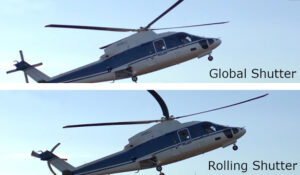
Global Shutter
- Captures the entire frame at the same moment in time
- Produces a uniform image without motion-based distortion
Rolling Shutter
- Captures the image sequentially, line by line (typically top to bottom)
- Each portion of the frame is recorded at a slightly different moment
While rolling shutter operates extremely quickly, this staggered capture can create visible distortions when either the camera or the subject is moving.
Because rolling shutter sensors are more cost-effective and energy-efficient, they are widely used in consumer and commercial devices, making them very common in forensic video.
Examples
Rolling shutter artifacts are most noticeable in scenarios involving rapid motion:
Rotating Components
- Helicopter rotors, fans, or propellers may appear bent or warped
- In reality, these components remain straight—the distortion results from sequential image capture
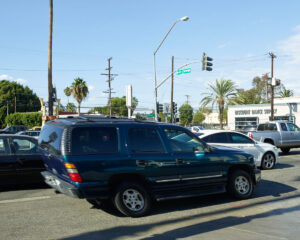
Fast-Moving Vehicles
- Vehicles may appear elongated, compressed, or skewed
- The apparent shape can vary depending on direction and speed relative to the camera
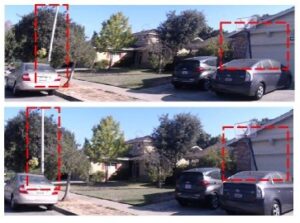
Stationary Objects in Motion
- Poles, buildings, and other vertical features may appear tilted
- This often occurs when the camera itself is moving quickly
Camera Movement
- Rapid panning or vibration can introduce a “wobble” or “jello effect”
- Different parts of the image shift inconsistently within the same frame
In each case, the observed distortion is not a true representation of the object’s shape or position at a single moment in time.
Approach to Analysis
When analyzing video that may be affected by rolling shutter, the focus is on identifying and accounting for these artifacts before drawing conclusions.
This typically includes:
- Evaluating the type of camera and capture method
- Identifying visual indicators of rolling shutter distortion
- Assessing how motion (object or camera) influences the image
- Applying tools or workflows that compensate for rolling shutter effects
Many modern photogrammetry and reconstruction platforms incorporate techniques that help reduce or correct these distortions, improving the reliability of measurements and motion analysis.
Conclusion
Rolling shutter is a common characteristic of the cameras that capture much of today’s video evidence. While the distortions it introduces are often subtle, they can meaningfully impact how footage is interpreted.
A careful, informed approach ensures that conclusions are based on what actually happened, not on how the camera recorded it.