
A video shows us exactly what happened, right? Case closed. Or is it?
Cameras are everywhere, with reports stating Americans are captured on surveillance cameras from 30 to 250 times per day, depending on the security level of their work, commute, and daily movement in public spaces. Considering the prevalence of traffic cameras, CCTV systems, video doorbells, and dash cameras, it’s easy to see how quickly our images are captured. Turning to current events, it’s now common for a public shooting, accident, or mass incident to be captured by multiple cameras, whether a bystander’s phone, a body camera, or surveillance footage. The nature of these events thrusts the videos instantly into the national spotlight, where they can be tried in the court of public opinion. However, video evidence alone does not tell a complete or accurate story, contrary to a viewer’s beliefs. Cameras don’t capture depth, distance, speed, or perspective accurately on their own. Have you ever been deceived?
It is estimated that 71% of Americans (243 million) were tricked, fooled, or just unknowingly accepted Will Ferrell was a giant human amongst the elves at the North Pole in the 2003 movie Elf.
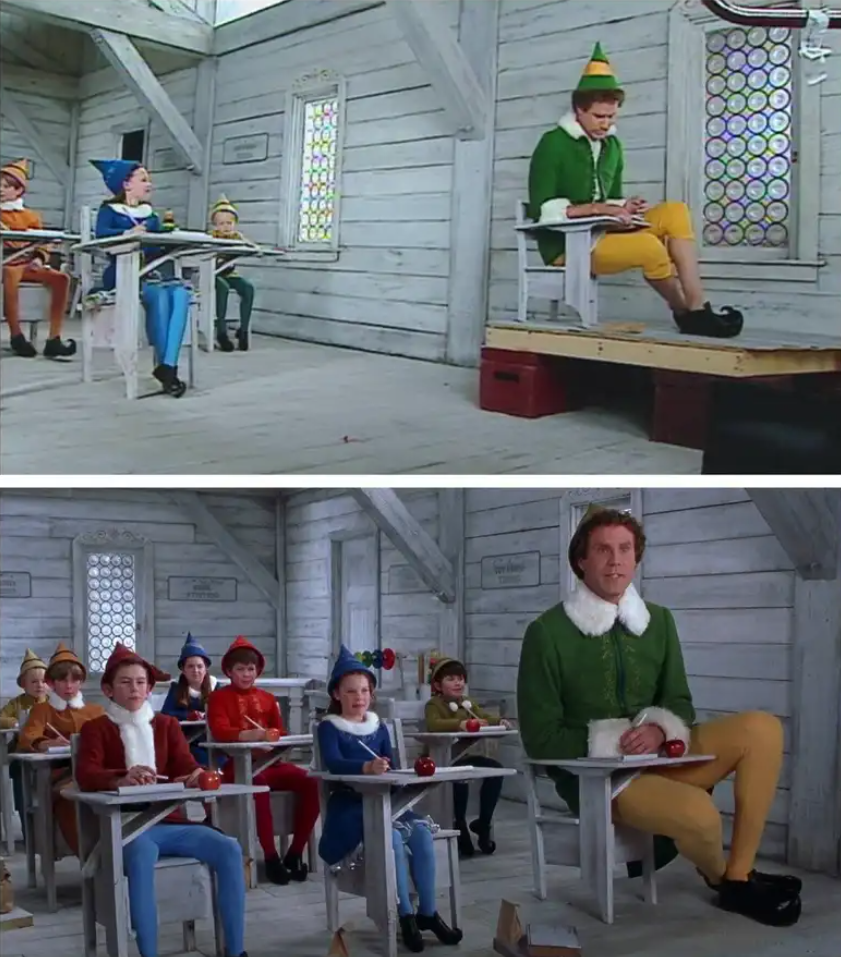
How did they do it? Force Perspective. Forced perspective was the technique used in the production of the movie to make Will Ferrell appear much larger than his castmates. Camera height and angle play a major role in how tall or short someone appears in a video. A low camera angle can make the subject appear taller, bigger, and potentially more imposing. A high camera angle does the exact opposite, making the person look shorter and smaller in the video.
In short, video faithfully records light from its lens’ perspective, but it doesn’t replicate human depth perception. What appears to be clear evidence of distance or closeness on screen is often an optical illusion shaped by the camera itself. Relying on a single video for spatial judgments risks misinterpretation. These same camera ‘tricks’ can be used intentionally or unintentionally alter the viewer’s perspective. When performing a forensic investigation, here are a few of the key components that must be accounted for to determine the actual distances, speeds, locations of objects in film and photograms.
Depth Perception & Lens Distortion
The saying goes, “The camera doesn’t lie.” Unfortunately, that is not true; especially when it comes to depth perception. Human eyes see depth in 3D thanks to two slightly different views from each eye (binocular vision) plus everyday clues like things looking smaller when farther away, overlapping objects, converging lines, and how things shift as we move. A single camera, though, captures everything flat from one fixed spot. It loses the stereo effect from two eyes, so we’re left guessing depth using only those basic clues, which the camera can easily distort. Common wide-angle or fisheye lenses (found in most surveillance, doorbell, and body cameras) stretch the edges and compress the middle, making distances look much bigger or smaller than they really are.
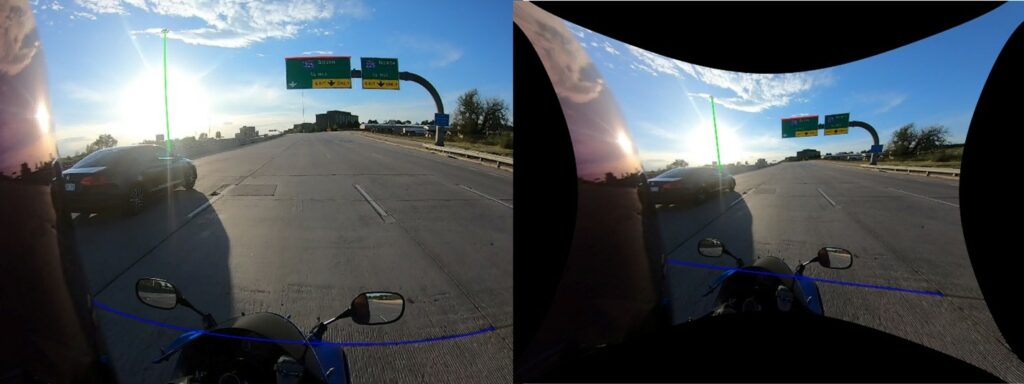
Example of lens distortion on Go Pro camera. The image on the right has been corrected for distortion; the degree of distortion is now more clearly distinguished by the image borders.
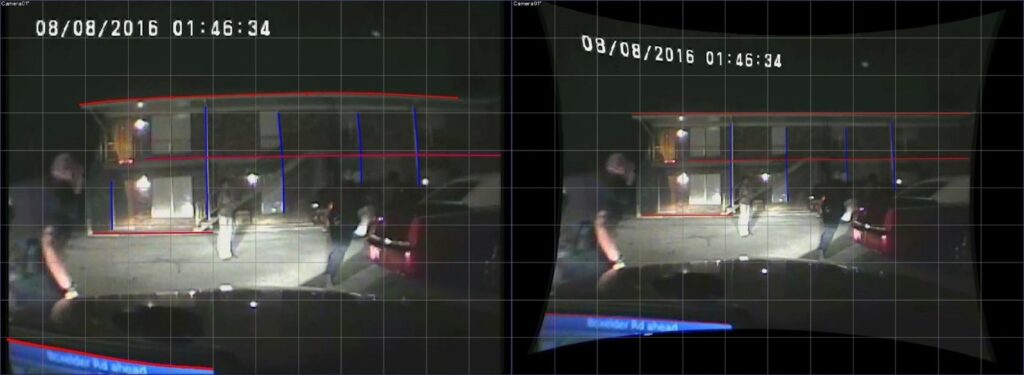
Example of lens distortion on Go Pro camera. The image on the right has been corrected for distortion; the degree of distortion is now more clearly distinguished by the image borders.
Judging Speed
In addition to the above, speed is especially unreliable. Approaching vehicles often seem to accelerate dramatically due to the camera’s perspective, while departing ones appear slower. Without reliable reference points or multiple angles, it’s nearly impossible to judge true velocity accurately. What looks like reckless speed on screen may be normal movement from that viewpoint.
Limitations of Field-of-View
Another fundamental limitation of video evidence is its narrow field of view, which captures only a small slice of the scene and excludes crucial context happening just outside the frame. What the camera sees is cropped by the lens, camera positioning, and framing, often omitting people, objects, or actions that completely change the interpretation of events. For example, a suspect who appears to lunge aggressively might have been reacting to an unseen threat or person approaching from the side or outside the video frame. Or an officer’s reach for a weapon could follow an off-screen movement that provoked it. Without the surrounding, unseen context, we viewers fill in the gaps with assumptions. This can lead to conclusions that feel certain but are built on incomplete information.
Personal Interpretation
Combine all the technical issues and add one more layer: our own personal interpretation. Clear as it may seem, video footage is still subject to interpretation, and individual viewers can have very different conclusion based on the same video. A recent article in Scientific American discusses the neuroscience behind various forms of bias we bring to video footage. The article quotes Sandra Ristovska, an associate professor of media studies at the University of Colorado Boulder. “Seeing is not just what our eyes physically see, but also the experiences and ideas that viewers bring to images.” Beyond the technical challenges, we apply our own figurative lens to video footage, whether it be biases, political beliefs, or morals. Personal experiences help shape our perspectives, but they shape our personal reality, which can blind us to how sharply they differ from those of others or the forensic science applied to the incident.
Digital Media Forensics
Digital Media Forensics (DMF) is a process developed by Knott Laboratory to eliminate issues arising from a single piece of video evidence and bring clarity to chaotic incidents. DMF applies scientific and engineering principles to analyze the full electronic picture—video, audio, images, and other digital evidence—to accurately determine what happened during an incident. The goal is to remove ambiguity, establish facts, and present findings in a way that is precise, measurable, and understandable to non-technical audiences. Follow this link to learn more about Digital Media Forensics.