Background
A woman using a mobility scooter was injured along an ADA accessible route outside a commercial property. Knott Laboratory was retained to investigate the incident, evaluate site conditions, and determine whether the condition complied with applicable codes and accessibility standards.
As the woman approached and attempted to ascend a curb ramp, the scooter encountered a change in elevation between the asphalt access aisle for the accessible parking space and the concrete ramp. When the rear wheels of the scooter encountered the change in level, her scooter came to an abrupt halt, causing it to tip and her to fall and sustain injuries.
By the time Knott was engaged, the ramp had been fully repaired and the change in level was eliminated. Our investigation combined site inspection, 3D laser scanning, and photogrammetric reconstruction to evaluate the conditions present at the time of the incident and identify the root cause of the fall.
Investigation and Analysis
Knott conducted a site inspection which included evaluating the parking lot, ADA spaces, access aisle, curb ramp, and surrounding pedestrian pathways.
The engineering team reviewed:
- Post-incident photographs
- Site documentation and case materials
- Physical conditions of the accessible route
To evaluate the conditions that existed at the time of the incident, Knott applied advanced forensic engineering techniques:
- 3D laser scanning was used to capture precise measurements of the current site
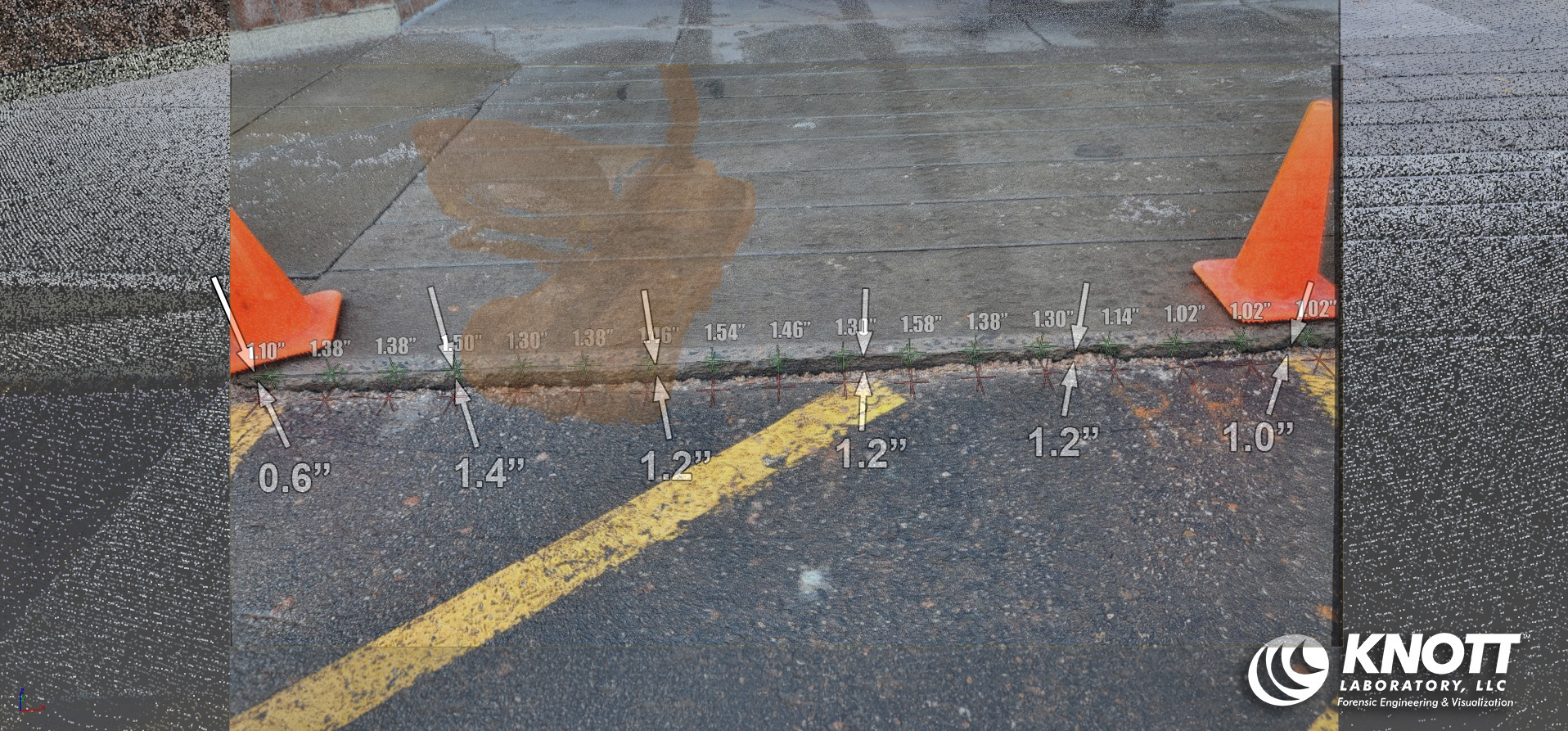
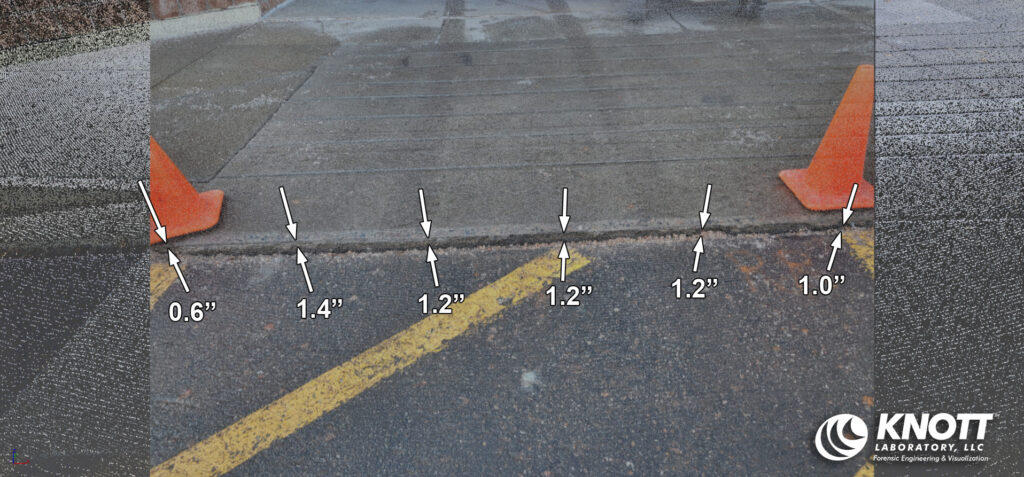
- Photogrammetry was performed using post-incident photographs and laser scan data to reconstruct pre-repair conditions
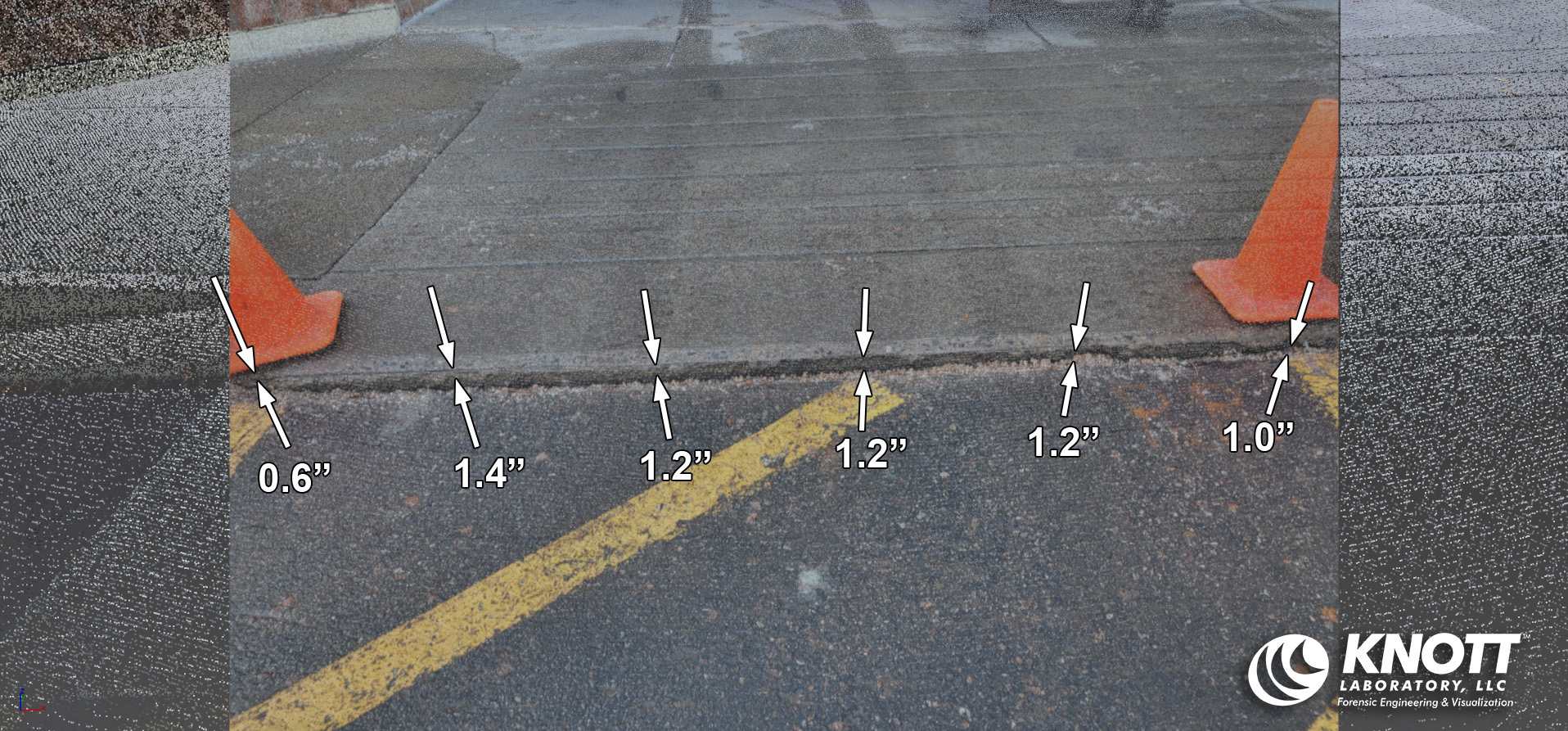
This process allowed the team to generate a point cloud model and accurately measure the elevation difference that existed at the time of the fall.
Hazard Identification and Measurement
Through photogrammetric analysis, Knott determined that the vertical change in elevation that was present at the base of the curb ramp was approximately 1.7 inches.
This elevation change was located directly along the only accessible route connecting the ADA parking spaces to the building entrance.
Engineering and Code Evaluation
Knott evaluated the condition against recognized safety standards and codes, including:
- International Building Code (IBC)
- International Fire Code (IFC)
- DA standards for accessible design
- Industry guidance on walkway surface safety
The Engineering analysis showed that:
- Changes in elevation significantly smaller than 1.7 inches are recognized as fall hazards
- Accessible routes are required to provide a continuous, unobstructed path of travel
- Transitions at curb ramps must be flush and free of abrupt changes
The subject condition did not meet these requirements and represented a non-compliant accessible route condition.
Prior Repairs and Maintenance History
Evidence showed that prior repair efforts had been performed at the location, including concrete grinding intended to reduce the elevation difference.
However, the asphalt continued to settle over time, the elevation change increased, and additional maintenance or repair was not performed prior to the incident. In addition, a tenant of the building had emailed the building owner approximately 5 months prior stating that other pedestrians, including those with walkers, had almost fallen at the same location due to the change in level.
This indicated that the hazardous condition was known or should have been known prior to the fall.
Mobility Scooter Evaluation
Knott also evaluated the capabilities of the mobility scooter involved in the incident.
- The scooter had an approximate ground clearance of 1.4 inches
- The measured elevation change (1.7 inches) exceeded this threshold
Despite this, the engineering analysis concluded that:
- The incident was not the result of improper scooter operation
- The failure was attributable to the unsafe condition of the accessible route
Findings and Conclusions
Based on the available evidence and engineering analysis, Knott Laboratory concluded:
- A 1.7-inch elevation change existed at the transition between the access aisle and the curb ramp
- The plaintiff encountered this condition while traveling along the designated accessible route
- The elevation change caused the mobility scooter to become unstable and tip over
- The condition constituted a recognized fall hazard
- The condition did not comply with applicable building codes and ADA accessibility standards
- Evidence of prior repairs demonstrated prior knowledge of the hazardous condition
- The incident resulted from a failure to properly maintain or repair the accessible route
In summary, the fall was caused by a failure to reasonably maintain the ramp free of abrupt changes in level which created a foreseeable and non-compliant change in elevation along an accessible path of travel.